

Best Igloo Cooler Alternatives for Dry Food Storage
Table of Contents
- Why Campers Are Switching Away from Standard Igloo Coolers
- Rotomolded Cooler Comparison: How Construction Affects Ice Retention
- How to Keep Food Dry in a Cooler: The Two-Level Solution
- Best Igloo Cooler Alternatives: Cooler Racks Product Lineup
- Feature and Price Comparison Table
- Weight-to-Capacity Efficiency and Long-Term Wear Analysis
- Repairability and Spare Parts Availability for Cooler Racks
- Frequently Asked Questions
Last Updated: September 29, 2026
Why Campers Are Switching Away from Standard Igloo Coolers
The problem with a standard hard-sided cooler was never the cold. It's the water. Ice melts, meltwater pools at the bottom, and by day two every sandwich, every bag of produce, and every container you packed is sitting in it. At Cooler Racks™, we built our whole product line around that single failure point, because it's the one most cooler buyers only notice after the first trip.
Standard Igloo-style coolers do their job: they hold ice and they hold volume. What they don't do is separate your food from the melt. The result is the familiar mid-trip routine of digging through slush to find a dry snack that no longer exists.
That gap is why so many campers, anglers, and overlanders now look for best Igloo cooler alternatives that solve organization rather than just capacity. The fix isn't a bigger cooler. It's a second level inside the one you already own.
Rotomolded Cooler Comparison: How Construction Affects Ice Retention
Rotomolded coolers are built by loading polyethylene resin into a hollow mold, then rotating that mold on two axes inside an oven so the melted plastic coats the interior evenly. The result is a single seamless shell with thick, uniform walls and no joined seams. Injection-molded coolers, the category most standard Igloo models fall into, are formed as two separate halves that are later joined, which caps how much insulation foam can be packed between the inner and outer walls.
That construction difference is the whole ballgame for ice retention. A rotomolded cooler typically carries 2 to 3 inches of polyurethane insulation on all six sides plus a thick rubber gasket and a heavy-duty latch system. A thin-walled injection-molded box might carry well under an inch on the walls and rely on a friction-fit lid. More insulation and a tighter seal mean less ambient heat reaches the ice, so the same block of ice lasts measurably longer in a rotomolded build.
Here's the trade-off most buyers only feel after the first trip. Rotomolded coolers are heavy before you put anything in them.
How to Keep Food Dry in a Cooler: The Two-Level Solution
Keeping food dry in a cooler comes down to one principle: never let food sit at the bottom where meltwater collects. Elevate it.
A few practical rules make the setup work:
- Use block ice rather than cubed ice where you can. It melts slower and produces less standing water.
- Keep the drain plug closed during transport and open it at camp to shed meltwater.
- Pack food in the upper layer and drinks in the lower layer so you're not rearranging everything to reach a can.
- Leave the 2 x 2-inch grid clear so cold air and loose ice can pass through.
Best Igloo Cooler Alternatives: Cooler Racks Product Lineup
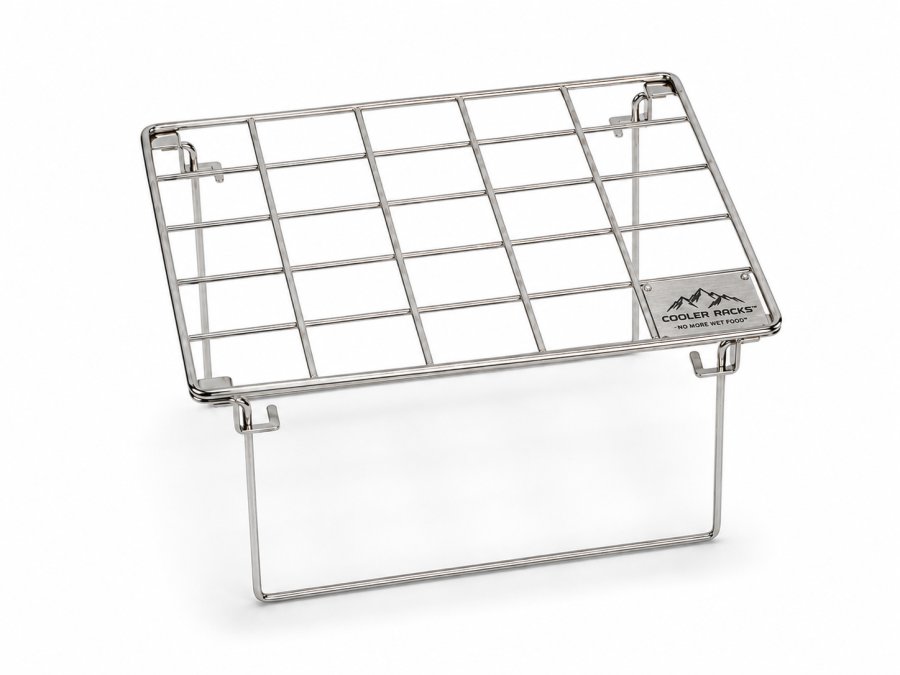
The strongest Igloo cooler alternatives aren't replacements for your cooler at all. They're stainless steel cooler racks that turn a single-level ice chest into a two-level organizer, so food stays dry above while drinks stay cold below. Every rack here is made from premium 304 food-grade stainless steel, is rust-resistant and dishwasher-safe, and is designed to fit hard-sided coolers only.
CR-SS-10 Compact Cooler Rack (10")
The CR-SS-10 is the entry point and the most flexible piece in the line. At 10 x 11 x 7 inches, it fits coolers with at least 10 inches of interior length, 11 inches of interior width, and 7 inches of usable interior height. There are no plastic parts, no coatings, and no assembly. It's $29.99, and it's the right pick if you're testing the two-level setup or packing a smaller cooler for day trips.
CR-SS-15 Full Size Cooler Rack (15")
Step up to the CR-SS-15 and you get a 15 x 11 x 7-inch platform, which fits coolers with at least 15 inches of interior length and the same 11-inch width and 7-inch height. It's $34.99 and dishwasher-safe. For a mid-size cooler used by a couple or a small family, this single rack covers most of the floor.
Full Cooler System (25") Bundle
Two racks, one 10-inch and one 15-inch, create a 25-inch food platform. It fits coolers with at least 25 x 11 x 7 inches of usable interior space. At $59.99, it saves $4.99 versus buying both racks separately. This is the most popular configuration.
Maximum Coverage Cooler Rack System (30") Bundle
Two 15-inch full-size racks give you the largest platform in the line: 30 inches of coverage for coolers with at least 30 x 11 x 7 inches of usable interior space. It runs $64.99, again with a $4.99 bundle saving. This is the setup for large coolers on boat decks and tailgate spreads.
Double Cooler Rack Setup (20") Bundle
Two CR-SS-10 compact racks create a 20-inch platform for coolers with at least 20 inches of interior length, 11 inches of width, and 7 inches of usable height. At $54.99, it saves $4.99 over two separate compact racks. It's the pick when your cooler is long but shallow in usable height.
Feature and Price Comparison Table
| Setup | Racks Included | Platform Width | Fits Cooler Interior (min.) | Price |
|---|---|---|---|---|
| CR-SS-10 Compact | 1 x 10" | 10" | 10" x 11" x 7" | $29.99 |
| CR-SS-15 Full Size | 1 x 15" | 15" | 15" x 11" x 7" | $34.99 |
| Double Cooler Rack Setup | 2 x 10" | 20" | 20" x 11" x 7" | $54.99 |
| Full Cooler System | 1 x 10" + 1 x 15" | 25" | 25" x 11" x 7" | $59.99 |
| Maximum Coverage System | 2 x 15" | 30" | 30" x 11" x 7" | $64.99 |
Every setup ships for a flat $10. Measure the inside of your cooler before ordering, because the 7 inches of usable interior height is the spec people most often overlook.

Weight-to-Capacity Efficiency and Long-Term Wear Analysis
Weight-to-capacity efficiency is the ratio of how much usable food space a cooler setup gives you against how much the whole rig weighs when loaded. Rotomolded coolers score poorly here: the thick walls that buy ice retention also add pounds before you've put a single item inside.
Repairability and Spare Parts Availability for Cooler Racks
Repairability is the angle almost no cooler accessory review covers, and it's the one that matters most after the second summer. Most cooler organizers on the market are built as sealed, one-piece units: molded plastic trays, coated wire baskets, or riveted frames. When a leg cracks or a weld rusts through, there's no hinge to replace, no gasket to swap, and no way to reattach the broken piece.
- Plastic tray corners. Molded trays crack at the corners first, usually where the leg meets the platform, because that's where flex concentrates.
- Coated wire welds. Powder-coated or chrome-plated wire baskets rust at the weld joints once the coating chips, and the coating always chips.
- Hinges and clips. Folding mechanisms with plastic hinges or snap clips loosen over time and eventually stop locking open.
- Gaskets and seals on the cooler itself. Lid gaskets compress and dry out, drain plugs crack, and latches lose tension. On many coolers these are user-replaceable; on some they aren't.
Frequently Asked Questions
Is Yeti really that much better than Igloo?
Yeti coolers use rotomolded construction with thicker insulation, which typically provides longer ice retention than standard Igloo models. However, the gap narrows when you improve organization inside your existing cooler. Adding a stainless steel cooler rack keeps food dry and separates items, so you get better results from the cooler you already own without spending $300 or more on a new rotomolded brand.
How do rotomolded coolers compare to traditional plastic coolers?
Rotomolded coolers are built with a single-piece shell and thicker polyurethane insulation, which slows heat transfer and extends ice retention. Traditional plastic coolers have thinner walls and seams that let warmth in faster. If you already own a hard-sided cooler, a cooler rack helps you make the most of its capacity by keeping food elevated and dry while cold air circulates below.
What features should I look for in a high-performance cooler?
Look for a gasket seal, heavy-duty hinges, a locking mechanism, and adequate insulation thickness. Interior capacity and weight-to-volume ratio matter for portability. For dry food storage, add a cooler organizer rack made from food-grade 304 stainless steel. It should be rust-resistant, dishwasher-safe, and sized to fit your cooler's interior dimensions.
How do I know which Cooler Racks size fits my Igloo cooler?
Measure the interior length, width, and usable height of your cooler before ordering. The CR-SS-10 Compact Rack fits spaces at least 10" x 11" x 7". The CR-SS-15 Full Size Rack needs 15" x 11" x 7". Bundles cover 20", 25", or 30" of interior length. Cooler Racks provides a Size Guide and verifies fit for approximately 90% of hard-sided cooler models.
Will a stainless steel cooler rack rust after a few seasons?
Cooler Racks uses 304 food-grade stainless steel, which resists rust and corrosion from ice, meltwater, and saltwater environments. The racks have no plastic parts or coatings that can peel or crack. They are dishwasher-safe for easy cleaning after each trip. Several customers report using them season after season without loosening legs or rust spots.