

Folding Cooler Rack for Camping: 2026 Buyer's Guide
Table of Contents
- Why a Folding Cooler Rack Beats Repacking Your Ice Chest
- Quick Comparison: Cooler Rack Sizes and Prices
- Best Cooler Accessories for Road Trips: What Earns Its Space
- How to Organize a Camping Cooler With a Rack System
- Preventing Soggy Food in Coolers: Ground Clearance and Fit
- Folding Cooler Rack Sizes: Which Setup Fits Your Ice Chest?
- Frequently Asked Questions
Last Updated: October 2, 2026
Why a Folding Cooler Rack Beats Repacking Your Ice Chest
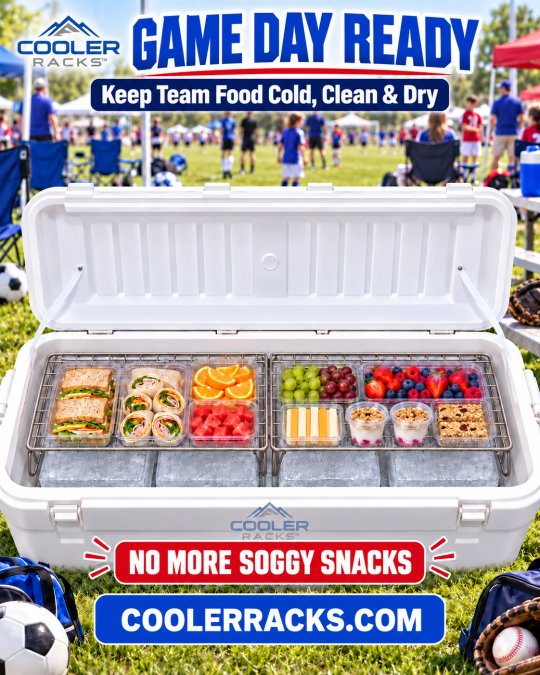
A folding cooler rack is a stainless steel platform with foldable legs that sits inside a hard-sided cooler, holding food above the ice and meltwater while drinks stay cold underneath.
Quick Comparison: Cooler Rack Sizes and Prices
Cooler Racks™ sells four folding rack configurations, all built from the same 304 stainless steel with folding legs and a 2 x 2-inch ice grid. The right one depends on your cooler's interior length.
| Setup | Coverage | Interior Space Needed | Price |
|---|---|---|---|
| CR-SS-15 Full Size Rack | 15″ | 15″ × 11″ × 7″ | $32.99 |
| Double Cooler Rack Setup | 20″ | 20″ × 11″ × 7″ | $57.99 |
| Full Cooler System | 25″ | 25″ × 11″ × 7″ | $60.99 |
| Maximum Coverage System | 30″ | 30″ × 11″ × 7″ | $63.99 |
Best Cooler Accessories for Road Trips: What Earns Its Space
Space in the truck is finite, so cooler accessories have to justify themselves. The best ones solve a day-one problem: food getting wet, drinks getting buried, or gear sliding around. A folding rack earns its space because it folds flat when not in use and creates usable storage when it is.

What earns a spot:
- A folding cooler rack, for separating food from meltwater
- Block ice, which melts slower than cubes and keeps the cooler drier
- A small dry bag for phones, keys, and matches
- A bottle opener you can't lose
How to Organize a Camping Cooler With a Rack System
Knowing how to organize a camping cooler comes down to three layers: ice at the bottom, drinks in the middle, food on top. Cold air sinks and water pools low, so ice goes in first, spread evenly. Drinks go directly on the ice, where they get coldest and you can grab them without disturbing anything else. The rack goes on top, and food goes on the rack.
A few things that make the system work better:
- Use block ice when you can. It lasts longer than cubes and produces less standing water.
- Keep food in containers or sealed bags, even on the rack. The rack keeps food out of water, but it doesn't seal anything.
- Group by meal. Breakfast items in one corner, lunch and snacks in another.
- Leave the drain plug accessible. You'll want to drain meltwater at some point, and a packed cooler makes that harder.
Preventing Soggy Food in Coolers: Ground Clearance and Fit
Preventing soggy food in coolers is mostly a ground clearance problem: food at the bottom of a cooler is food sitting in water, no matter how carefully you packed it. Meltwater collects at the lowest point, and if your food is at the lowest point, your food gets wet.
The mechanism: why the water line rises
A 10-pound block of ice produces about 1.2 gallons of water when it melts. In a typical 50-quart chest with a 20 by 11-inch interior footprint, that's roughly 1.5 inches deep, and by day two, with partial melting and drainage from drinks, the water line commonly sits between 2 and 4 inches.
Ground clearance is also an ergonomics problem
Most rack coverage stops at "keeps food dry." The second benefit is the one your back notices. A cooler on the ground forces you to bend to knee height every time you reach in, and a loaded 50-quart chest can weigh 40 to 60 pounds. Raising the food platform 7 inches inside the cooler means you reach down to the rack, not the floor of the chest.
Fit matters as much as clearance
A rack that's too small slides around and leaves food exposed; one that's too large won't sit flat. Cooler Racks™ racks have been verified to fit 86 cooler models, and the size guide lists them by interior dimensions. Measure three numbers inside your cooler, with the lid open and the drain plug closed:
- Interior length (front to back, along the long axis). This determines which rack size you need. Match it to the coverage column in the size chart.
- Interior width (side to side). Every rack needs at least 11 inches. A narrow cooler, think a slim 20-quart, won't take a full-size rack even if it's long enough.
- Usable interior height (from the floor to the underside of the lid, minus any lid recess or built-in cup holders). You need at least 7 inches of clear height above the ice line. This is the number people forget, and it's the one that causes returns.
Cooler-by-cooler fit notes
Universal-fit racks work across most hard-sided coolers, but fit varies by brand family:

- Rotomolded premium coolers (the thick-walled, heavy-lid style) tend to have generous interior height and flat floors, so a 7-inch rack usually clears. Their interiors are also more likely to be rectangular rather than tapered, which means a full-coverage rack sits flat.
- Injection-molded value coolers often have tapered interior walls and a molded lid recess. Measure at the narrowest point, not the widest, or the rack will wedge.
- Wheeled coolers frequently have a raised internal hump over the wheel wells. That hump eats usable floor length, so a rack sized to the exterior length won't fit.
- Soft-sided coolers are out entirely. No rigid floor, no stable walls, no level legs.
If you only remember one thing: food above the water line stays dry, and food below it doesn't. The second thing to remember is that "above the water line" is a measurement, not a guess, 7 inches of clearance and 11 inches of width are the two numbers that decide whether a rack works in your cooler.
Folding Cooler Rack Sizes: Which Setup Fits Your Ice Chest?
The right folding cooler rack size comes down to one number: your cooler's interior length in inches. In practice:
Double Cooler Rack Setup (20″) →
- 15 inches or less of interior length: a single CR-SS-15 Full Size Rack is your only option, and it's enough for a small cooler.
- 20 inches: the Double Cooler Rack Setup gives you full two-level coverage with two compact racks.
- 25 inches: the Full Cooler System is the most popular configuration, pairing one compact and one full-size rack.
- 30 inches or more: the Maximum Coverage System uses two full-size racks for the largest food platform.
Weight capacity and stability: what the rack will actually hold
A folding rack is a platform, not a shelf. Its job is to hold food above the water line while the cooler carries the weight of ice and drinks below, so the load on the rack is usually light and the load on the cooler floor is heavy.

A few practical limits:
- Distribute, don't concentrate. A 12-pack of cans set in one corner of the grid puts all its weight on a few wire intersections. Spread heavy items across the platform or keep them below the rack with the drinks.
- Keep the center of gravity low. The rack raises your food, but it also raises the cooler's overall center of gravity if you load the top heavily. On a tailgate or a boat, that's a tipping risk. Load the bottom first, then the rack.
- Check the legs, not just the grid. The folding legs are the load path. If a leg doesn't sit flat on the cooler floor, because of a wheel-well hump or a tapered wall, the rack rocks, and a rocking rack spills. Test the fit empty before you load it.
- Don't use the rack as a step or a seat. It's rated for food, not body weight. The grid will deform under a point load it wasn't designed for.
Material durability: stainless steel vs. aluminum vs. coated steel
Rack material is where cheap products fail first.
- 304 stainless steel (what Cooler Racks™ uses) resists corrosion from meltwater, salt, and acidic drink spills. It's heavier than aluminum, but needs no coating to chip or hide rust, and no plastic hinges to crack in cold weather.
- Aluminum is lighter, which matters when counting ounces. But bare aluminum can pit and oxidize in prolonged contact with saltwater and acidic liquids, and aluminum racks often rely on plastic or nylon hinges and feet that become the failure point.
- Powder-coated or painted steel is the cheapest option and the most likely to rust. The coating protects the steel until it scratches, and a cooler interior is a scratchy environment. Once the coating breaks, rust starts at the exposed spot and spreads underneath.
The failure pattern on budget racks is consistent: plastic hinges crack, coated steel rusts at the joint, and the rack stops folding flat. Stainless steel with no plastic parts avoids all three.
Setup and breakdown: what folding actually means
A folding rack earns its space because it stores flat. The sequence:
- Unfold the legs. They swing out from the underside of the grid and lock into the open position. No tools, no assembly.
- Set the rack in the cooler. It should sit flat on the floor with all four legs in contact. If it rocks, the cooler floor isn't flat, check for a wheel-well hump or a molded ridge.
- Load the cooler bottom-up. Ice first, then drinks, then the rack, then food. Loading in this order means you never have to lift the rack out to add ice.
- Break down in reverse. Lift the rack out, fold the legs flat against the grid, and store it. Folded, the rack is thin enough to slide behind a truck seat, into a tote, or against the wall of a garage shelf.
Versatility across cooler sizes
One rack can serve more than one cooler if the sizes overlap. A 15-inch rack fits any cooler with at least 15 inches of interior length and 11 inches of width, a wide range of 20- to 50-quart chests. If unsure, start with the rack size matching your largest cooler's interior length: slightly small still works; too large doesn't fit at all.
Anglers and boaters who want provisions separated from the catch and the ice, and families running a large cooler for a multi-day road trip.
Frequently Asked Questions
Why should you use a folding cooler rack while camping?
A folding cooler rack creates a second level inside a hard-sided cooler so food sits above the ice and meltwater instead of in it. That means sandwiches, produce, and containers stay dry while drinks stay cold underneath. The folding legs let the rack collapse flat for compact storage in a truck bed, trunk, or gear bin, so it travels without eating space you need for other camping gear.
What is the best way to keep food dry inside a cooler?
Keep food out of the meltwater entirely. A stainless steel rack like the CR-SS-15 Full Size Cooler Rack ($32.99) elevates food about 7 inches above the ice, and its 2 x 2-inch grid lets loose ice pass through while blocking food from falling in. Pair the rack with block ice for longer trips, and pack items you want coldest, like drinks, below the rack.
Are stainless steel cooler racks better than plastic stands?
Stainless steel holds up better over seasons of use. Cooler Racks uses 304 food-grade stainless steel that is rust-resistant, dishwasher-safe, and has no plastic parts or coatings that can crack or peel. Plastic stands can become brittle in cold temperatures and may absorb odors over time. Steel also transfers cooler air through the legs, helping the upper level stay cold.
How do you choose the right size cooler rack for your ice chest?
Measure the inside of your cooler first. The CR-SS-15 needs at least 15 x 11 x 7 inches of usable interior space, while the Double Cooler Rack Setup (20") needs at least 20 inches of interior length. For larger coolers, the Full Cooler System (25") at $60.99 and the Maximum Coverage Cooler Rack System (30") at $63.99 combine two racks for full coverage. Check the size guide before ordering.
Do folding cooler racks save space in a vehicle?
Yes. The folding legs collapse so the rack stores flat when not in use, which matters when you are packing a vehicle for a road trip or overlanding setup. Instead of a fixed shelf or bulky insert that takes up room year-round, a folding rack tucks into a gear bin or under a seat and only takes up cooler space when it is actually holding food.
Packing a cooler well takes more than ice and a good lid. It takes a system that keeps food dry, drinks cold, and everything findable without digging through slush. Cooler Racks™ builds folding 304 stainless steel racks with 7 inches of elevation, folding legs for compact storage, and a 2 x 2-inch grid that lets ice fall through. They're rust-resistant, dishwasher-safe, and verified to fit 86 cooler models. Get started with Cooler Racks™ and stop repacking your ice chest every morning.