

Boat Ice Chest Seat: The Complete Buying and Setup Guide
Last Updated: November 9, 2026
Quick Summary
A boat ice chest seat is a cooler fitted with a cushioned lid that doubles as seating, saving deck space on small boats. Choose a medium-firm closed-cell foam cushion in marine-grade vinyl or waterproof fabric, sized 1 to 2 inches smaller than the flat lid top and secured with snaps, Velcro, or stainless brackets.
- Measure the flat lid top inside the raised rim, then subtract 1 to 2 inches from each dimension.
- Closed-cell foam stays light, resists mold, and supports an adult without bottoming out.
- Keep snaps and screws at least 1 inch in from the lid rim to avoid cracking.
- Aim for a cushion top 17 to 19 inches above the deck for comfortable seating.
- Rinse cushions and stainless hardware with fresh water after every saltwater trip.
Table of Contents
- Why a Boat Ice Chest Seat Beats a Standard Cooler on Deck
- Marine Cooler Seat Cushion Materials That Survive Salt and Sun
- Sizing Your Boat Ice Chest Seat for Comfort and Safe Weight Capacity
- Installation and Mounting: How to Secure a Cooler Seat to a Boat Deck
- Swingback Cooler Seat: A Comfort Upgrade for Long Days on the Water
- Best Cooler Accessories for Road Trips That Also Work on the Boat
- Keeping Food Dry Under Your Boat Ice Chest Seat
- Maintenance, Cleaning, and Long-Term UV and Saltwater Protection
- Frequently Asked Questions
Why a Boat Ice Chest Seat Beats a Standard Cooler on Deck
A boat ice chest seat is a cooler fitted with a cushioned lid that doubles as seating. On a small boat, every square foot counts, so a cooler that also works as a bench earns its place.
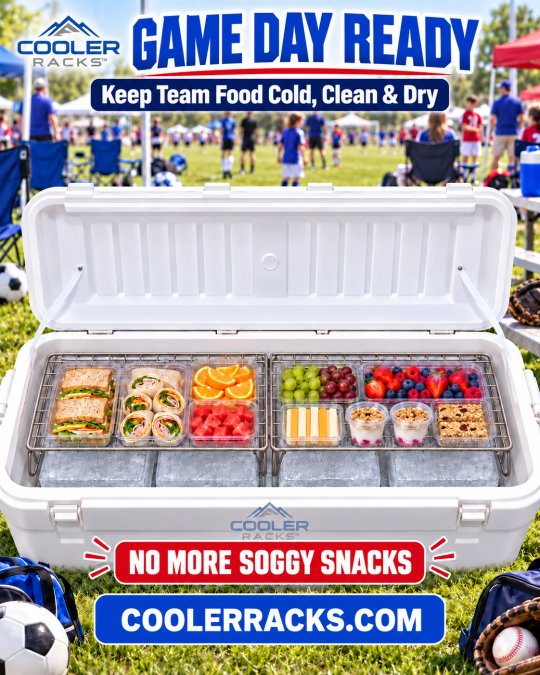
Cooler Racks™ makes stainless steel racks that sit inside hard-sided coolers to keep food dry above the ice.
Marine Cooler Seat Cushion Materials That Survive Salt and Sun
Salt and ultraviolet light destroy ordinary upholstery faster than almost anything else on a boat. A marine cooler seat cushion needs materials rated for both; standard furniture foam and fabric break down within a season or two.
Marine-Grade Vinyl vs. Waterproof Fabric
Marine-grade vinyl is the default for most boat ice chest seat cushions: it wipes clean, sheds water, and resists mold while intact. Choose UV-resistant formulations, since cheap vinyl cracks and turns chalky in sun.
Waterproof fabric, usually coated polyester or acrylic, breathes better than vinyl and stays cooler against the skin. It costs more and needs re-treatment, but holds up on boats stored under cover.
| Material | Best For | Watch Out For |
|---|---|---|
| Marine-grade vinyl | Open boats, heavy sun, easy cleanup | Cracks if not UV-stabilized |
| Waterproof coated fabric | Covered storage, hot climates | Coating wears with scrubbing |
| Closed-cell foam core | Any cushion that gets wet | Firmer feel than open-cell |
| Stainless steel hardware | Saltwater environments | Lower-grade steel rusts |
Closed-Cell Foam and Cushion Density
Closed-cell foam is the right core for any cushion that lives on the water: it does not absorb water like open-cell foam, so it stays light and will not grow mold inside.
A common mistake is buying a soft, thick cushion because it feels comfortable in the store; on a boat, soft foam compresses flat and offers no support. Go medium-firm for a boat ice chest seat, roughly the feel of a firm car seat.
Sizing Your Boat Ice Chest Seat for Comfort and Safe Weight Capacity
Sizing comes down to four numbers: lid dimensions, cushion overhang, seat height, and load-bearing capacity. Get all four right and the cushion looks factory-installed and stays put; get one wrong and you either crack a lid or sit on a pad that slides every time the boat rolls.
How to Measure a Cooler Lid for a Custom Fit
Measure the flat, usable top of the lid, not the outer rim. Most rotomolded and hard-sided lids have a raised lip or recessed channel, and a cushion spanning the full outer footprint will overhang and catch on dock lines, tackle bags, and console edges.
- Close the lid and confirm the latch is engaged so it sits in its loaded position.
- Measure length and width across the flat top, inside the raised rim.
- Subtract 1 to 2 inches from each dimension so the cushion stays off the rim and the edge does not peel up when someone shifts weight.
- Measure lid thickness at the front edge to see how much side skirt a fitted cushion can wrap.
- Note latch and hinge locations; any strap, snap base, or base plate has to clear them.
A common pattern is a lid measuring roughly 24 x 16 inches on the flat top; a cushion cut to about 22 x 14 inches fits cleanly with a small reveal on every side.
Universal vs. Custom Fitment
Universal cushions are sized in broad ranges and held on with straps, Velcro, or a flexible base.
Custom-fit cushions are cut to a specific lid footprint, often with a molded base plate or a skirt that drops over the lid edge.
A middle path many boaters use: a universal cushion plus a rigid base plate cut to the lid dimensions.
Weight Capacity and Load Distribution
This is the part most buyers skip, and where a cooler seat can actually fail. A cooler lid is engineered to hold contents in and keep cold air trapped, not automatically as a seat.
- Distribute, don't concentrate. A base plate or firm, full-footprint cushion spreads an adult's weight across the lid; a small center pad puts the entire load on the least supported area.
- Watch the lid flex. Press down firmly on the closed lid before mounting. Noticeable center deflection means you need a base plate, with hardware kept well in from the rim.
- Keep hardware off the hinge line. Snaps and screws near the hinge or latch take repeated stress every time the lid opens and can crack the plastic.
If you are unsure whether your lid is up to the job, sit on it with the cushion in place on the trailer and have someone watch the lid edge.
Seat Height and Ergonomics
Height matters for comfort on long days. A seat that sits too low forces your knees up and strains your lower back; too high and your feet dangle, which is worse on a moving deck because you lose bracing.
If you are weighing size and capacity tradeoffs, our guide on how to choose the right cooler size for any trip walks through dimensions and volume for different trip lengths.
Installation and Mounting: How to Secure a Cooler Seat to a Boat Deck
A cooler seat has to stay put when the boat rolls, and there are three reliable ways to secure one: mounting snaps, adhesive Velcro, and stainless steel brackets or tie-downs. The right method depends on whether you want a permanent mount, a setup you can move between boats, or something in between.
Choosing a Mounting Method
| Method | Best For | Trade-off |
|---|---|---|
| Mounting snaps | Permanent installs, open boats, heavy use | Requires drilling the lid; not movable |
| Adhesive Velcro | No-drill installs, smaller cushions, calm water | Holds less in chop; adhesive degrades with heat and salt |
| Stainless brackets and tie-downs | Larger cushions, swingback seats, rough water | More hardware and more install time |
Mounting snaps are the most secure permanent option: a snap base screws into the lid and the matching snap on the cushion locks it down.
Adhesive Velcro is the fast, no-drill option. Heavy-duty marine-grade Velcro holds well on a clean, textured lid and lets you pull the cushion off for cleaning.
Stainless steel brackets and tie-downs cover heavier setups, including swingback seats and two-person cushions.
Step-by-Step Installation
- Empty and dry the cooler. Adhesive will not bond to a damp or cold surface.
- Clean the lid with isopropyl alcohol. Salt film and cooler residue defeat adhesive and interfere with snap placement; wipe, then let it flash off.
- Test-fit the cushion and mark the position. Center it on the flat top, confirm it clears the latch and hinge, and mark corners with painter's tape.
- Mark hardware at least an inch in from the rim. Snaps too close to the edge can crack the plastic when the lid flexes.
- Drill pilot holes sized to the screw. This prevents splitting on rotomolded lids; wrap tape on the bit as a depth stop so you do not punch into the insulation.
- Bed the hardware in marine sealant. A dab under each snap base or bracket keeps water out and slows corrosion.
- Fasten, then check the lid seal. Confirm the gasket still seats and the latch engages; a cushion that presses on the latch or lifts the lid edge lets cold air escape.
- Load-test at the dock. Shift your weight side to side; any creak, flex, or rim movement means the hardware or base plate needs attention.
Pre-Installation Checklist
- Lid wiped clean with alcohol and fully dry
- Cushion test-fitted and position marked
- Hardware at least 1 inch in from the lid rim
Common Failure Modes
Watch out: the two most common install failures are hardware placed too close to the lid rim, which cracks the plastic under load, and adhesive Velcro applied to a lid that was not fully dry, which lets the cushion peel off in the first chop. Both are avoidable with the checklist above.
A third failure is over-tightening. Stainless screws driven hard into plastic lids strip the threads or star-crack the surrounding material. Snug plus sealant beats torque every time.
If you move the cooler between boats, favor Velcro or a bracket-and-strap setup over snaps. Snaps are permanent by design, and a lid full of snap bases is awkward to use as a plain cooler again.
Swingback Cooler Seat: A Comfort Upgrade for Long Days on the Water
A swingback cooler seat adds a folding backrest to the cushion, changing how long you can comfortably stay seated.
The tradeoff is footprint. A swingback needs clearance behind the seat to fold, so measure that space before buying.
Ergonomically, a backrest reduces lower-back fatigue during long idle stretches. If your days involve hours of waiting between bites, the swingback earns its space.
Best Cooler Accessories for Road Trips That Also Work on the Boat
The best cooler accessories for road trips are the ones that pull double duty on the water. A cooler that travels from truck bed to boat deck should be organized the same way in both places.
- A folding stainless steel rack to keep food above the meltwater
- A block ice setup for longer trips without electricity
Inside the cooler, organization matters most. Our folding racks come in two sizes, CR-SS-10 at 10 x 11 x 7 inches and CR-SS-15 at 15 x 11 x 7 inches, and both give 7 inches of elevation. For more ideas, see our roundup of cooler accessories for road trips.
Keeping Food Dry Under Your Boat Ice Chest Seat
Melted ice is the enemy of every packed lunch, and a boat ice chest seat sits right on top of the problem. Water pools at the bottom of the cooler, and anything resting in it turns soggy.
A cooler rack does exactly that. Our 304 food-grade stainless steel racks have a 2 x 2-inch grid that lets loose ice pass through while holding food up above the ice.
Two practical habits help as well. Drain the cooler at the end of each day, and pack food in containers rather than loose. For the full method, read how to keep food dry in a cooler, and if water has already crept in, how to keep food out of cooler water covers the fixes step by step.
Maintenance, Cleaning, and Long-Term UV and Saltwater Protection
Routine care separates a cushion that lasts several seasons from one that fails in a year.
Clean vinyl with mild soap and water, then dry fully before storing; never store a damp cushion against the lid, since trapped moisture starts mold.
Stainless hardware needs the same attention: rinse, dry, and check screws and snaps each season for looseness or surface rust.
Store the boat covered when possible.
Melted ice punishes food in any cooler.
Frequently Asked Questions
How do you secure a boat ice chest seat to a boat deck?
For a permanent mount, use stainless steel hardware to avoid rust in a saltwater environment. Always check that the cooler itself is strapped down or wedged so it cannot slide when the boat moves. A non-slip backing on the cushion adds grip, and keeping the cooler lid clear of obstructions lets you open it without unstrapping the seat.
Are cooler seat cushions waterproof?
Marine-grade vinyl and quick-dry fabrics shed splashes, and closed-cell foam will not soak up water like open-cell foam. Mold-resistant materials and heavy-duty stitching help the cushion survive repeated wet use. Wipe it down after each trip and let it air dry fully before storing it so mildew does not form in the seams.
What is a swingback cooler seat and who is it for?
It adds ergonomic support for long days of fishing or cruising, and the backrest folds flat for storage. These seats suit anglers and families who spend hours on deck and want back support without a fixed pedestal seat. Check that the base fits your cooler lid and that the hinge hardware is stainless steel.
Can I use a boat ice chest seat with a soft cooler?
Cooler Racks™ are designed for hard-sided coolers only. A soft cooler collapses under a seated person and has no rigid lid for mounting snaps or Velcro. If you use a soft cooler, keep it for drinks and carry a separate hard-sided cooler with a seat cushion for seating. Measure your cooler lid before buying to confirm the fit.
