

Choosing a Cooler Rack for Aluminum Pontoons
Last Updated: November 17, 2026
Quick Summary
Choosing a cooler rack for aluminum pontoons means matching the rack to your cooler's interior first, then confirming the mount fits your rail or deck. Measure interior length, width, and height, identify your rail profile, and check mounted clearance before buying. No-drill clamps with a rubber or foam barrier protect thin aluminum rails from corrosion.
- Measure the cooler interior at the floor, since walls often taper toward the bottom.
- Common round aluminum pontoon rail runs roughly 1 inch to 1.25 inches outside diameter.
- A gallon of water weighs a little over 8 pounds, so ice and drinks add up fast.
- Use two straps in a cross pattern and recheck tension after the first hour.
- Isolate stainless hardware from aluminum with foam, rubber, or a plastic shim.
Table of Contents
- Why a Cooler Rack Changes a Day on an Aluminum Pontoon
- Rail-Mounted vs Deck-Mounted: Choosing a Pontoon Cooler Mount
- No-Drill Pontoon Cooler Rail Mount Options That Protect the Rail
- Measuring Rail Dimensions, Cooler Width, and Available Height
- Load Limits, Use, and Keeping the Cooler Secure Underway
- When a Pontoon Cooler Storage Rack Beats a Built-In Cooler Table
- Stainless Steel, Aluminum, and Galvanic Corrosion on a Pontoon
- Picking the Right Cooler Rack Size for Your Cooler and Deck
- Frequently Asked Questions
Why a Cooler Rack Changes a Day on an Aluminum Pontoon
Choosing a cooler rack for aluminum pontoons comes down to one problem: a cooler that slides, blocks the walkway, or soaks your food ruins the day.
Aluminum pontoons have thin-walled rails and a deck that punishes careless drilling, so a rack that works on a fiberglass fishing boat can rattle loose, corrode, or crack a rail if mounted wrong.
Below, we break down rail versus deck mounting, no-drill options, measuring, load limits, and corrosion.
Rail-Mounted vs Deck-Mounted: Choosing a Pontoon Cooler Mount
A pontoon cooler mount comes in two families. Rail-mounted setups clamp or strap to the pontoon rail and keep the deck clear. Deck-mounted setups bolt or strap to the floor and hold more weight with less use.
Rail mounting wins on space: the cooler rides at hip height, out of the walking path. The trade-off is that weight hanging off a rail creates a lever arm, and every wave works the clamp looser.
Deck mounting wins on stability. A cooler strapped flat to the deck sits low, spreads its load, and barely moves at speed. The cost is floor space and a permanent footprint.
Where the Cooler Should Sit on the Deck
The rear deck is usually the best home for a pontoon cooler storage rack. It keeps the cooler out of the main seating area, close to the swim platform, and away from the helm where foot traffic is heaviest.
- Keep it off the center walkway. A cooler in the aisle is a trip hazard.
- Balance the load. Put a loaded cooler near the boat's centerline or offset it with other gear so the pontoon doesn't list.
- Leave rail clearance. If you rail-mount, confirm the cooler doesn't block the gate, the bimini frame, or a cleat you actually use.
Watch out: a cooler that blocks a boarding gate looks fine at the dock and becomes a real problem the first time someone climbs aboard with an armload of gear.
No-Drill Pontoon Cooler Rail Mount Options That Protect the Rail
A no-drill pontoon cooler rail mount is the safest starting point for aluminum. Drilling a pontoon rail invites corrosion at the hole and voids resale value.
Clamp-style mounts tighten around the rail with a rubber or foam interface. Strap-style mounts loop over the rail and cinch down.
Rail protection matters. A bare metal clamp against a bare aluminum rail will rub, and rubbing plus lake water equals corrosion.
If you want the full walkthrough on attaching hardware to aluminum without drilling, our guide on how to mount a boat cooler rack on aluminum surfaces covers the surface prep and hardware choices in detail.
Measuring Rail Dimensions, Cooler Width, and Available Height
Measure the inside of the cooler, not the outside. Manufacturers quote capacity in quarts, and that number tells you almost nothing about whether a rack fits, a 45-quart cooler from one brand can have a narrower interior than a 40-quart cooler from another.
Work in this order: cooler interior first, rail second, mounted clearance third. That sequence prevents the most common mistake: buying a rack that fits the cooler but not the spot on the boat where the cooler has to live.
Step 1: Measure the Cooler Interior
Use a tape measure and take all three numbers at the widest usable point, not at the lid lip or a molded handle recess.
- Interior length. Measure front to back along the floor. A 15-inch rack needs at least 15 inches of usable interior length; add a quarter inch of slack so the rack drops in without forcing.
- Interior width. Measure side to side. Most racks run 11 inches wide, so confirm 11 inches of clear interior width at the floor, not at the rim where the cooler may taper.
- Usable interior height. Measure from the floor to the underside of the closed lid. A rack with 7-inch legs needs 7 inches of clearance above it, plus room for the lid to close without pressing on the rack or its contents.
Watch out: cooler walls often taper toward the bottom, so a width measured at the rim can be an inch wider than the width at the floor where the rack actually sits.
Step 2: Identify the Rail Profile and Diameter
Pontoon rails are not one standard size. Common round aluminum rail runs roughly 1 inch to 1.25 inches in outside diameter, and some boats use square or rectangular sections. Identify what you actually have before you shop for a clamp.
- Measure outside diameter with a caliper or a tape wrapped around the tube (circumference divided by 3.14). Measure where the clamp will sit, not at a welded joint or bend.
- Note the shape. Round, square, and rectangular rail each need a different clamp saddle; a round clamp on a square rail contacts at one point and will work loose.
- Check wall thickness if you can. Thin-walled aluminum can crush or dent under a clamp, creating a stress point and a place for corrosion to start. If the rail flexes when you press it, treat it as light-duty and spread the load with a wider saddle or backing plate.
Step 3: Confirm Mounted Clearance
With the rack and cooler sized, check the assembled footprint against the boat.
- Lid swing. Open the lid through its full arc and confirm it clears the bimini frame, rail cap, and any seat back.
- Gate and helm clearance. Confirm the mounted cooler does not block a boarding gate, helm seat travel, or a cleat you actually use.
- Deck footprint. If you deck-mount, mark the footprint with tape and walk around it; less than about 18 inches of walkway becomes a trip hazard.
| What to Measure | Where | Why It Matters |
|---|---|---|
| Interior length | Inside cooler, floor, front to back | Rack must fit without forcing |
| Interior width | Inside cooler, floor, side to side | 11-inch racks need 11 inches clear at the floor |
| Usable height | Inside cooler, floor to closed lid | 7-inch legs need 7 inches above |
| Rail outside diameter | At the clamp location, not a joint | Clamp saddle must match the tube size |
| Rail shape | Round, square, or rectangular | Round clamps do not seat on square rail |
| Rail run length | Between stanchions and fittings | Clamp needs straight rail to grip |
| Lid swing and gate clearance | On the boat, lid fully open | Prevents blocked gates and bimini contact |
Write the numbers down and photograph the rail with the tape in frame. Match the cooler interior numbers first, then the rail numbers, then the clearance numbers, a rack that wins on two out of three still will not fit.
Load Limits, Use, and Keeping the Cooler Secure Underway
A cooler that stays put at the dock can still shift at speed. Underway stability comes down to four things: the loaded weight, the rack's stated capacity, how the cooler is tied down, and where the weight sits relative to the mount.
Estimate the Loaded Weight First
Start with the empty cooler weight from the manufacturer, then add contents. A gallon of water weighs a little over 8 pounds, and ice is close to that, so 20 pounds of ice, a case of drinks, and food can easily add 40 to 60 pounds. Weigh the loaded cooler on a bathroom scale before you mount it; guessing low is the most common error.
Understand Why Rail Mounts See More Force
A rail-mounted cooler hangs off the rail, turning it into a lever. The farther the cooler's center of gravity sits from the clamp, the more torque the clamp and rail see when the boat rolls or hits a wake, the same cooler that feels solid on the deck can produce several times the load at the clamp when mounted high and far out.
- Keep heavy items low and toward the center of the cooler and the boat.
- Mount close to a stanchion so the clamp is near a supported point rather than mid-span on the rail.
- Do not stack gear on top of the cooler; that raises the center of gravity and adds load the rack was not rated for.
Tie-Down Sequence That Holds
Straps are not optional, and how you run them matters as much as using them.
- Use two straps in a cross pattern over the cooler, pulling down and slightly outward so the cooler is pressed into the rack or deck rather than pulled sideways.
- Anchor to hard points, not the rail cap, a cleat you need, or a bimini fitting. Deck-mounted setups should anchor to the deck or a dedicated tie-down, not the cooler's own handle.
- Use cam buckles or ratchets with pads where the strap crosses the cooler edge, so vibration does not saw through the strap.
- Check tension after the first hour, then again at the end of the day; a strap tight at the dock can be slack by lunch.
Watch out: a strap run over a sharp cooler edge or a rail fitting can chafe through in a single season, so inspect the strap where it contacts hardware every trip.
Vibration, Motion, and Hardware Checks
Boat motion works hardware loose in a way dock testing never reveals: engine vibration, wake impacts, and passengers moving around cycle the mount thousands of times a day. Check clamp bolts and strap anchors after every trip for the first month, then monthly.
For a deeper look at hardware and strapping methods that hold up, see our breakdown of secure mounting solutions for boat coolers that stay put.
When a Pontoon Cooler Storage Rack Beats a Built-In Cooler Table
A pontoon boat cooler table is convenient, but it solves a different problem than a cooler rack. The table gives you a flat surface and a dedicated cooler spot. It does not keep your food out of meltwater.
That distinction matters more than most buyers expect: a built-in table holds the cooler, but the cooler still fills with meltwater and your sandwiches still end up soggy.
The Pontoon Boat Cooler Table Trade-Off
Built-in cooler tables are heavy, permanent, and priced as a furniture upgrade. They also lock you into one cooler size and one location.
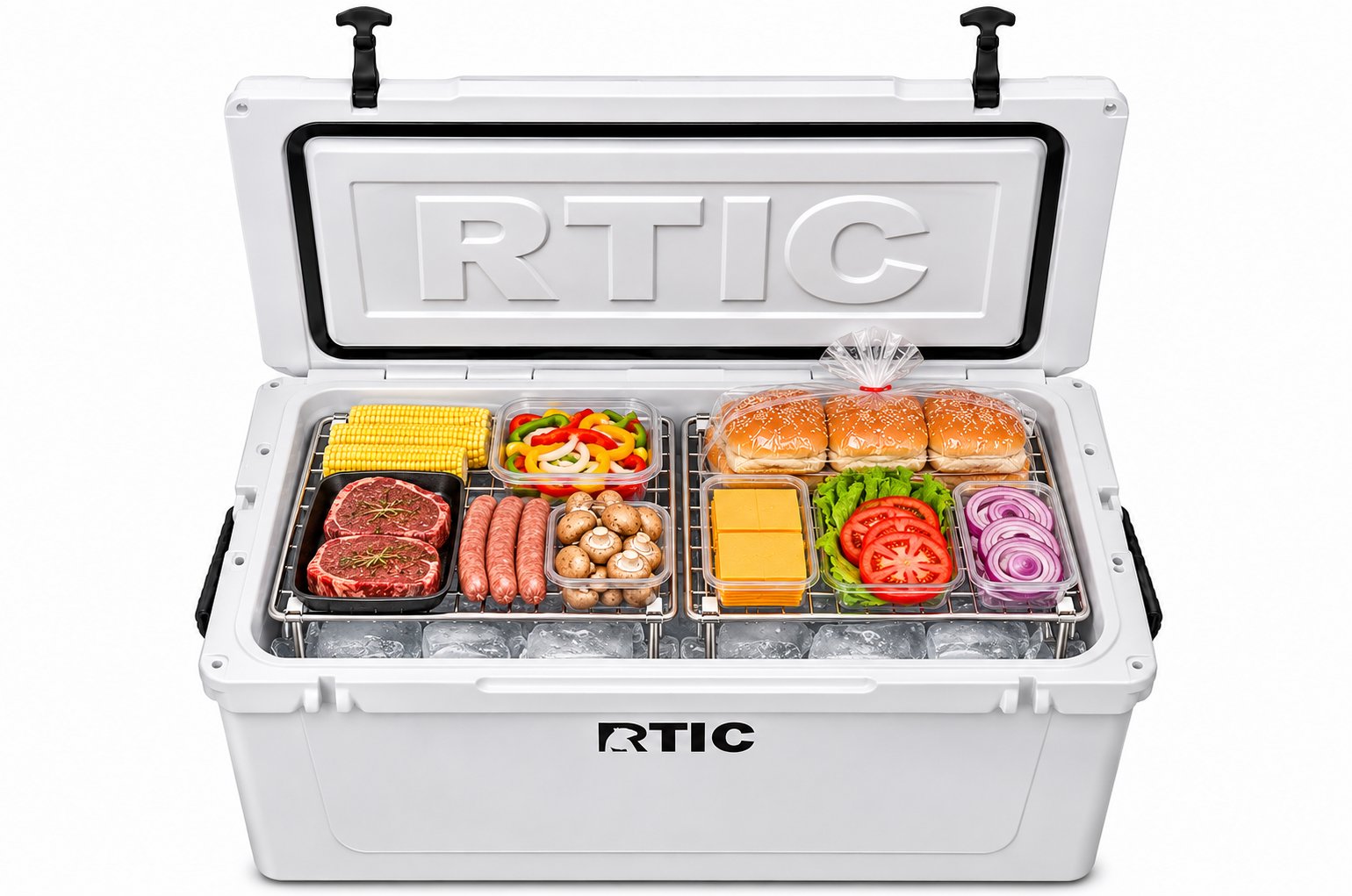
A pontoon cooler storage rack inside the cooler is lighter, removable, and works with the cooler you already own. It elevates food above the meltwater, so drinks stay cold below while sandwiches stay dry above.
Here is how we would decide:
- Choose a built-in table if you want a permanent serving surface and never move gear between boats.
- Choose an internal rack if you already own a hard-sided cooler, want it portable, and care more about dry food than a tabletop.
Stainless Steel, Aluminum, and Galvanic Corrosion on a Pontoon
Corrosion is the quiet killer of pontoon accessories. Aluminum and stainless steel sit at different points on the galvanic scale, and when they touch in lake water, the aluminum becomes the sacrificial metal.
Two rules keep this in check. First, isolate dissimilar metals with a barrier: foam, rubber, or a plastic shim between the stainless hardware and the aluminum rail. Second, rinse everything with fresh water after every saltwater or brackish trip.
304 stainless steel resists rust well in fresh water and holds up to regular cleaning; cheaper plated steel will pit and flake within a season.
Our racks are made from 304 food-grade stainless steel and are dishwasher-safe.
Picking the Right Cooler Rack Size for Your Cooler and Deck
Sizing is where most buyers get it wrong, so start with the cooler, not the boat.
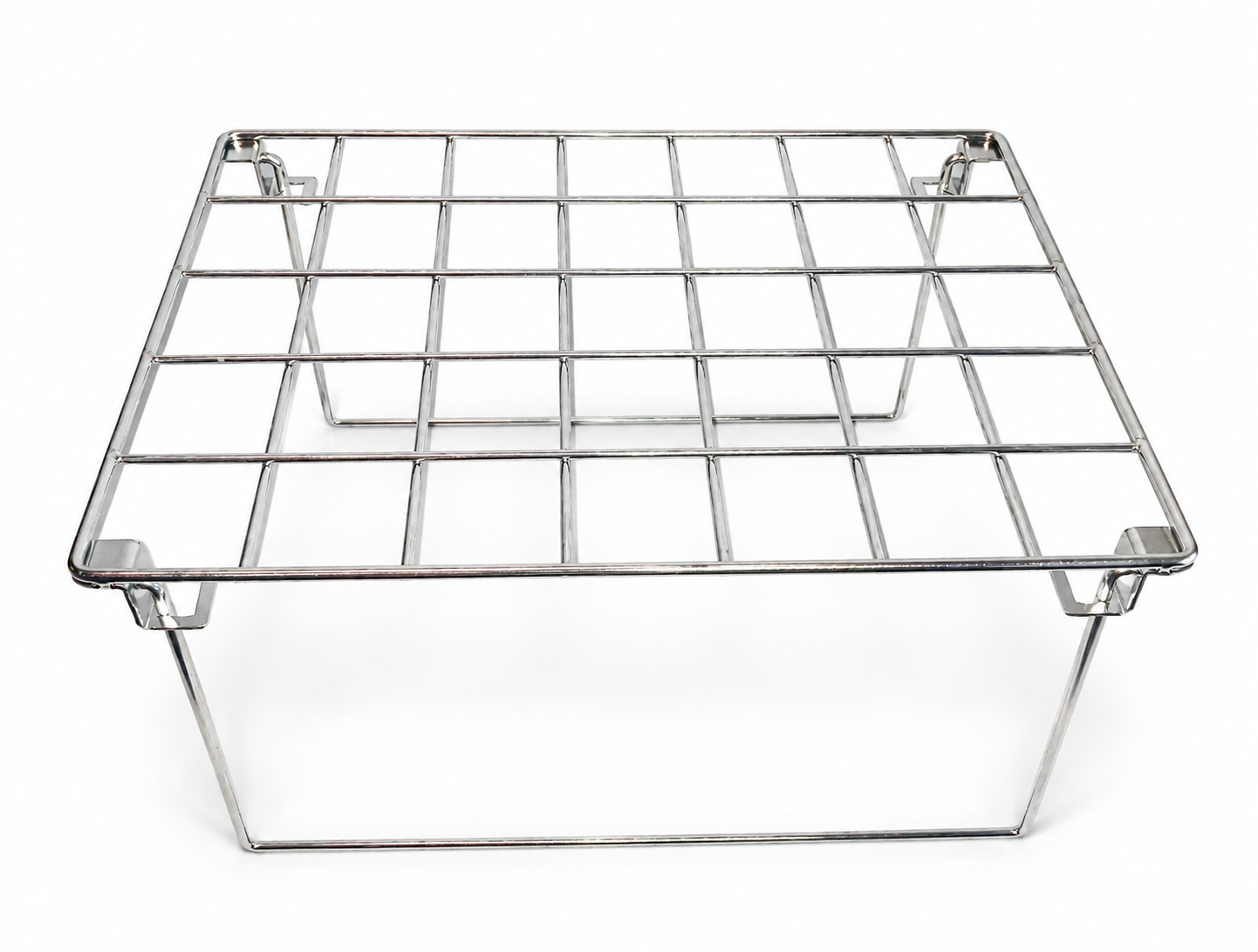
We make two sizes. The CR-SS-15 Full Size Cooler Rack measures 15 x 11 x 7 inches and suits mid-size hard-sided coolers. The CR-SS-10 Compact Cooler Rack measures 10 x 11 x 7 inches for tighter interiors.
For a side-by-side look at deck-ready hardware before you commit, our comparison of the best cooler rack systems for boat decks lays out the options. And if you are unsure whether a given rack fits your specific cooler, this cooler rack compatibility guide answers the fit question directly.
A quick starting checklist:
- Interior length is at least the rack length
- Interior width clears 11 inches
- Usable height clears 7 inches plus lid clearance
Picking a cooler rack for an aluminum pontoon rewards patience: measure twice, isolate the metals, strap it down, and check it after the first run.
Cooler Racks™ builds folding 304 stainless steel racks that keep food dry above the ice and drinks cold below.
Frequently Asked Questions
How do you mount a cooler on an aluminum pontoon?
You have two paths: bolt or clamp a mount to the deck, or attach a rail mount to the pontoon rail. Rail mounting avoids new holes in the deck and keeps the cooler off the walking surface. Whichever you pick, measure the rail diameter and the cooler's base first, then use tie-down straps to lock the cooler to the mount. Check the mount's rated capacity against the loaded weight of the cooler, ice, and contents before you head out.
Can you mount a cooler rack to pontoon rails without drilling?
Yes. A no-drill pontoon cooler rail mount clamps around the rail instead of putting screws through aluminum. That matters because every hole in a pontoon rail or deck is a future corrosion point. Use a clamp sized to your actual rail dimensions, add protective foam or a rubber pad so the clamp does not rub the finish, and re-check the clamp tension after the first few trips as vibration works hardware loose.
How much space should I leave around a cooler on a pontoon?
Leave enough clearance to open the lid fully and to walk past the cooler without stepping over it. On the rear deck, keep the cooler clear of the engine cowling and any fuel or battery access panels. If you use an interior rack, confirm at least 7 inches of usable interior height so food sits above the meltwater. Measure the inside of the cooler, not its advertised capacity, before ordering a rack.
Will a cooler rack fit my pontoon's rail or deck?
It depends on two measurements: rail diameter for a rail mount, and deck or cooler footprint for a deck mount. Pontoon rails vary in diameter, so a clamp that fits one boat may not fit another. For interior racks, check the cooler's usable interior length, width, and height. Cooler Racks lists fitment by interior measurements rather than cooler brand or quart capacity, which is the more reliable way to confirm a rack will work.
Cooler rack dimensions by model
