

7 Cooler Clearance Sale Traps That Waste Your Money
Last Updated: October 25, 2026
Quick Summary
A cooler clearance sale only saves you money when you pick the right capacity and type first, then verify the compare-at price against other retailers. Most clearance traps come from buying a marked-down cooler that is the wrong size, a soft bag when you need hard-sided storage, or a final-sale unit with no returns.
- Quart ratings include walls and lid recess, so usable space shrinks once ice goes in.
- Our racks fit hard-sided coolers only, so a discounted soft bag won't support food-above-ice storage.
- Confirm the return window, final-sale status, and manufacturer warranty in writing before paying.
- Late summer into early fall brings the steepest cooler markdowns as shelves reset for cold weather.
- Set price alerts on two or three models that fit your trip profile and ignore the rest.
Table of Contents
- Why Most Cooler Clearance Sale Hauls End Up in the Garage
- Trap 1: Buying a Cooler Size That Doesn't Match Your Trips
- The Cooler Size Guide: Quart Capacity vs What Actually Fits
- Trap 2: Ignoring Hard-Sided vs Soft Cooler Trade-Offs
- Trap 3: Trusting a Clearance Tag Without Checking the Compare-At Price
- Trap 4: Assuming Coolers on Sale Keep Ice the Same as Full-Price Models
- Trap 5: Skipping the Return Policy and Warranty Fine Print
- The Best Time to Buy a Cooler (and When Clearance Is a Distraction)
- Frequently Asked Questions
Why Most Cooler Clearance Sale Hauls End Up in the Garage
A cooler clearance sale looks like found money until the cooler is sitting in your garage three summers later, still tagged, still empty. Shoppers grab a marked-down ice chest because the price is right, then discover it's the wrong size, the wrong type, or not actually discounted at all. The result is a shelf full of regret.
The problem isn't that clearance coolers are bad. It's that clearance shopping flips the decision. Instead of choosing a cooler for your trips and then finding a deal, you start with the deal and reverse-engineer a reason to own it.
Below, we'll walk through the seven traps that turn a cooler clearance haul into garage clutter, plus the size guide and timing rules that keep you out of them. The good news: every trap is avoidable with about five minutes of prep before you check out.
Trap 1: Buying a Cooler Size That Doesn't Match Your Trips
The most common mistake is sizing the cooler to the discount, not the trip. A deep clearance price on a huge ice chest means nothing if you're a two-person weekend camper, and a tiny marked-down cooler won't cut it for a family beach day with drinks for six.
Match capacity to how you actually pack:
- Day trips and tailgates: a smaller cooler you can carry loaded, sized for drinks plus one meal.
- Weekend camping for two to four: a mid-size hard-sided cooler with room for food above and ice below.
- Group trips, fishing days, and long road trips: a large hard-sided cooler where organization matters as much as capacity.
If you're shopping storage rack systems to match a trip type, a comparison of cooler storage rack systems helps you see which setups fit which cooler sizes before you commit to a clearance find.
The Cooler Size Guide: Quart Capacity vs What Actually Fits
Quart ratings tell you volume, not usable space. A cooler's published capacity includes the walls, the lid recess, and every cubic inch the ice will occupy. What you can actually pack is smaller, and it shrinks further once ice goes in.
Here's how the common sizes shake out in practice:
| Cooler Size | Typical Use | What Actually Fits | Watch Out For |
|---|---|---|---|
| Under 30 quarts | Day trips, lunches | Drinks and a small meal | Little room once ice is added |
| 30-50 quarts | Weekend camping, 2-4 people | Food plus drinks for a short trip | Food sits in meltwater without a rack |
| 50-75 quarts | Family trips, tailgates | Meals and drinks for a group | Heavy when loaded; check vehicle fit |
| 75+ quarts | Group camping, fishing | Multi-day food storage | Needs two people to move |
Measure the interior, not the label. Once you've sized your cooler, a compatibility guide for cooler racks confirms which racks and inserts actually fit your specific model.
Trap 2: Ignoring Hard-Sided vs Soft Cooler Trade-Offs
Clearance racks blur the line between cooler types, and shoppers grab whichever is cheapest. That's a mistake, because hard-sided and soft-sided coolers solve different problems.
Hard-sided coolers hold ice longer, stack and sit stable in a truck bed, and accept internal organizers.
The trade-off that trips people up is organization. If you're weighing soft versus hard and wondering whether rack accessories work in a soft-sided model, whether racks work in soft coolers answers that directly.
Watch out: a soft cooler marked down 40% is still a soft cooler. If your goal is keeping sandwiches out of meltwater, buy the type that supports the setup you want.
Trap 3: Trusting a Clearance Tag Without Checking the Compare-At Price
A clearance tag is a claim, not a fact. Retailers print "compare at" prices that reflect an original list price the item may never have sold at, and a deep-looking markdown can land right back at the normal street price.
Verify before you buy:
- Check the same model at two or three other retailers to see the real going rate.
- Confirm the "compare at" figure matches the manufacturer's current list price.
- Look at the unit price, not just the discount percentage.
- Note whether the sale price requires a membership, rebate, or bundle.
A clearance cooler is only a deal if the final price beats what you'd pay for the same model elsewhere. A tag that says "was $X, now $Y" tells you nothing until you've checked $X.
Trap 4: Assuming Coolers on Sale Keep Ice the Same as Full-Price Models
Clearance doesn't change insulation, but it does change what you're buying. Sale coolers are often last year's model, a discontinued color, or a returned unit, and none of those carry the same ice-retention performance as the current lineup.
Insulation quality is the spec that matters. When you're comparing a discounted budget brand against a premium one, real-world ice retention comparisons matter more than the sticker.
Our advice: buy the cooler whose insulation matches your longest trip, then find the discount. Not the reverse.
Trap 5: Skipping the Return Policy and Warranty Fine Print
Clearance items often carry different terms than full-price stock, and the fine print is where a good deal goes bad. Many retailers shorten or eliminate returns on clearance, sell items "as-is," or exclude them from the standard warranty. The shoppers who avoid this trap treat the return policy and warranty as part of the price, not an afterthought.
Separate the Two Warranties
There are two warranties in play on any cooler purchase, and clearance changes them differently:
- The manufacturer's warranty covers defects in materials and workmanship. It usually survives a clearance purchase because it attaches to the product, not the sale. But it may not apply to open-box, refurbished, or floor-model units, and some manufacturers require proof of purchase from an authorized retailer.
- The retailer's return policy is the store's promise to take the item back. This is the one clearance most often changes. Final-sale, as-is, and shortened return windows are common on clearance, and some retailers exclude clearance items from price adjustments entirely.
Before you buy, confirm both in writing: the return window for clearance items specifically, whether the item is final sale or as-is, whether the manufacturer's warranty still applies, and the exact condition (new, open-box, refurbished, or floor model).
How to Inspect a Clearance Cooler Before You Pay
A quick inspection catches most clearance problems before they become returns you cannot make:
- Open and close the lid. The seal should compress evenly and the lid should sit flush. A warped lid or a gasket that does not contact the rim will leak cold air.
- Check the drain plug and hardware. Missing drain plugs, cracked hinges, and stripped lid latches are common on returned and floor-model units, and replacement parts are not always available for discontinued models.
- Look for stress cracks and UV damage. Sun-faded plastic and hairline cracks around the handles or hinges signal a cooler that sat outside or was dropped.
- Confirm the interior is dry and odor-free. A cooler returned after use can carry mildew or residue that is hard to remove.
- Ask for the condition in writing. If the tag says "open-box," ask what was opened and whether all parts are included.
The Math of a Final-Sale Cooler
A final-sale cooler is only a deal if the discount covers the risk. If the same model is returnable at a nearby retailer for a modestly higher price, the difference is effectively an insurance premium. For a cooler you plan to use hard for years, that premium is often worth paying. For a second cooler or a backup for the patio, a final-sale discount can be the better call.
The Best Time to Buy a Cooler (and When Clearance Is a Distraction)
Seasonality is the part of cooler clearance shopping most shoppers get wrong, because they treat "summer" as a single window.
Late summer into early fall (the deepest window). As retailers reset shelves for cold-weather inventory, seasonal coolers get pushed to clearance.
Spring pre-season markdowns. Retailers clear last year's models to make room for new arrivals. Discounts are usually shallower than fall clearance, but the inventory is fresher and the size run is more complete.
How to Monitor Clearance Stock Without Checking Daily
Shoppers who consistently land good cooler clearance deals do three things:
- Set a price alert on the exact model. Most major retailers let you watch an item and email you when the price drops. Pick two or three models that fit your trip profile and let the alerts do the work.
- Watch the size run, not just the price. When a cooler's available sizes start disappearing (for example, the 45-quart sells out while the 70-quart lingers), that is a signal the model is heading to clearance. Check back within a week or two.
- Check endcaps and the seasonal aisle in person. Clearance coolers are frequently moved off the main shelf to endcaps, seasonal aisles, or the garden section. Online listings often lag the in-store markdown, so a store visit during the transition windows can surface deals that never appear in search results.
When Clearance Becomes a Distraction
Clearance turns into a trap when it pulls you toward the wrong cooler. A marked-down 100-quart ice chest is a bad buy for a solo camper, and a cheap soft bag is a bad buy if you want organized, dry food storage.
Once you have the right cooler, a guide to packing a cooler for camping helps you get the most out of it from day one.
Frequently Asked Questions
When is the best time to buy a cooler on sale?
Late summer and early fall are when retailers clear out seasonal stock, and new model releases push older inventory to clearance. Watch for end-of-season markdowns on hard-sided and soft-sided coolers, plus holiday weekend promotions. The catch: clearance stock is limited and often final sale, so measure your cooler's interior first and confirm the return policy before you commit to a discounted cooler.
Are clearance coolers worth buying?
Often yes, if you check three things: the compare-at price is real, the cooler matches your actual trips, and the warranty still applies. A marked-down cooler with a short ice-retention rating or a no-return policy can cost more in the long run than a mid-priced model that fits. Clearance works best when you already know your needed capacity in quarts and your interior dimensions.
How do I choose the right cooler size for camping and tailgating?
Start with headcount and trip length, then convert to quarts. A day trip for two to four people usually fits a 20 to 45-quart cooler; multi-day camping for a family pushes into the 50 to 75-quart range. Measure the interior length, width, and usable height, not just the advertised capacity, since lid shape and handles eat into real space.
How can I keep food dry inside a clearance cooler?
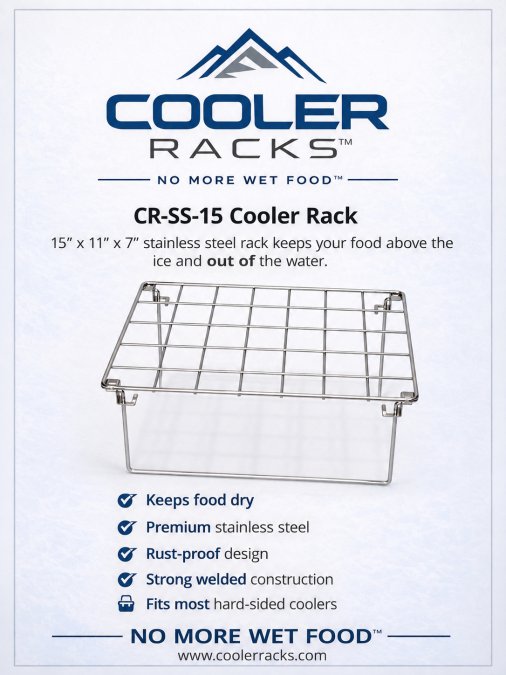
Elevate food above the ice line. Cooler Racks makes folding 304 stainless steel racks, the CR-SS-10 at $29.99 and the CR-SS-15 at $34.99, that hold food 7 inches above meltwater while drinks stay cold underneath. Measure your cooler's interior first: the compact rack needs at least 10 by 11 by 7 inches of usable space, and the full-size rack needs 15 by 11 by 7 inches.
A clearance cooler only pays off when it fits your trips and keeps your food dry. If you're tired of soggy sandwiches and digging through ice, Cooler Racks™ makes folding 304 stainless steel racks that elevate food above the meltwater and keep drinks cold below. Our racks are rust-resistant, dishwasher-safe, and verified to fit 86 cooler models. Get started with Cooler Racks™ and turn any hard-sided cooler into an organized, dry-food setup.
