

The Complete Cooler Size Guide for Every Trip
Last Updated: November 6, 2026
Quick Summary
The right cooler size depends on people, days, and ice: about 20 quarts for a day trip for two, near 50 quarts for a weekend for four, and 75 quarts or more for a multi-day family camping trip. Size up one tier from your food-only estimate, since ice takes up space.
- Use 10 quarts per person per day for food and drinks combined, then round up.
- Advertised quart capacity is total interior volume, not the space you can fill with food.
- Measure interior length, width, and height at the floor before buying.
- Small coolers run roughly 20-35 quarts and medium coolers roughly 40-70 quarts.
- For long trips, split into a food cooler and a drinks cooler to protect ice retention.
Table of Contents
- Cooler Size Chart: Quart Capacity by Group and Trip Length
- How Many Quarts Per Person for a Cooler
- Usable Capacity vs. Advertised Quarts: Why the Label Lies
- Cooler Dimensions and How to Measure Before You Buy
- Cooler Size for a Family: Small, Medium, and Large Categories
- Cooler Size for a Road Trip: Day Trips, Camping, and Tailgating
- Soft-Sided vs. Hard-Sided Cooler Sizing
- How to Pack a Cooler So Capacity Actually Works
- Frequently Asked Questions
Cooler Size Chart: Quart Capacity by Group and Trip Length
The right cooler size comes down to three numbers: how many people, how many days, and how much of that space ice will eat. This cooler size guide pairs a realistic quart chart with the interior measurements that actually decide whether a cooler fits your trunk, your truck bed, and your food.
Here is the short version. A day trip for two calls for roughly 20 quarts. A weekend for four lands near 50 quarts. A multi-day camping trip for a family of five needs 75 quarts or more.
Many campers, anglers, and tailgaters run into the same problem: the cooler was big enough on paper and too small in practice. The chart below is built to close that gap.
| Group Size | Trip Length | Recommended Quart Range | Typical Use |
|---|---|---|---|
| 1-2 people | Day trip | 20-30 quarts | Lunch, drinks, fishing day |
| 2-4 people | Day trip or overnight | 30-50 quarts | Tailgating, beach day |
| 2-4 people | 2-3 days | 50-65 quarts | Weekend camping |
| 4-6 people | 2-3 days | 65-90 quarts | Family camping, road trip |
| 6+ people | 3+ days | 90-150 quarts | Group camping, base camp |
Treat the range as a starting point, not a rule. The next two sections explain why the same group size can need two very different coolers.
How Many Quarts Per Person for a Cooler
The spread is wide because ice, not food, is the variable that moves it.
A cooler packed for three days spends a large share of its volume on ice. If you are using block ice for longer retention, expect it to occupy a meaningful slice of the interior. Loose cubed ice takes even more usable space because it leaves air gaps. That is why a 50-quart cooler can feel full before you have packed a single sandwich.
A useful approach is to size up one tier from your food-only estimate, since the extra quarts go to ice and to the air cold needs to circulate.
A Practical Capacity Calculator: People, Days, and Ice
-
Base: 10 quarts per person per day for food and drinks combined.
-
Buffer: round up to the next standard cooler size.
A worked example: two adults, three days, warm weather. That is 2 × 3 × 10 = 60 quarts, plus a 20-quart ice allowance, for 80 quarts. A 75-quart cooler is the realistic floor; a 90-quart model gives breathing room.
Run the same math for a family of four on a two-day trip: 4 × 2 × 10 = 80 quarts, plus ice, and you are looking at 90 quarts or larger.
Usable Capacity vs. Advertised Quarts: Why the Label Lies
Advertised quart capacity describes the total interior volume of the cooler, not the space you can fill with food. Walls, lid insulation, molded handles, and drain channels all consume interior room.
The gap widens with hard-sided rotomolded coolers, which carry thick insulation for ice retention. That insulation is why the cooler performs well and why the usable capacity runs smaller than the sticker suggests.
Two practical consequences:
- Never buy by quart alone. Check interior dimensions, then check them again.
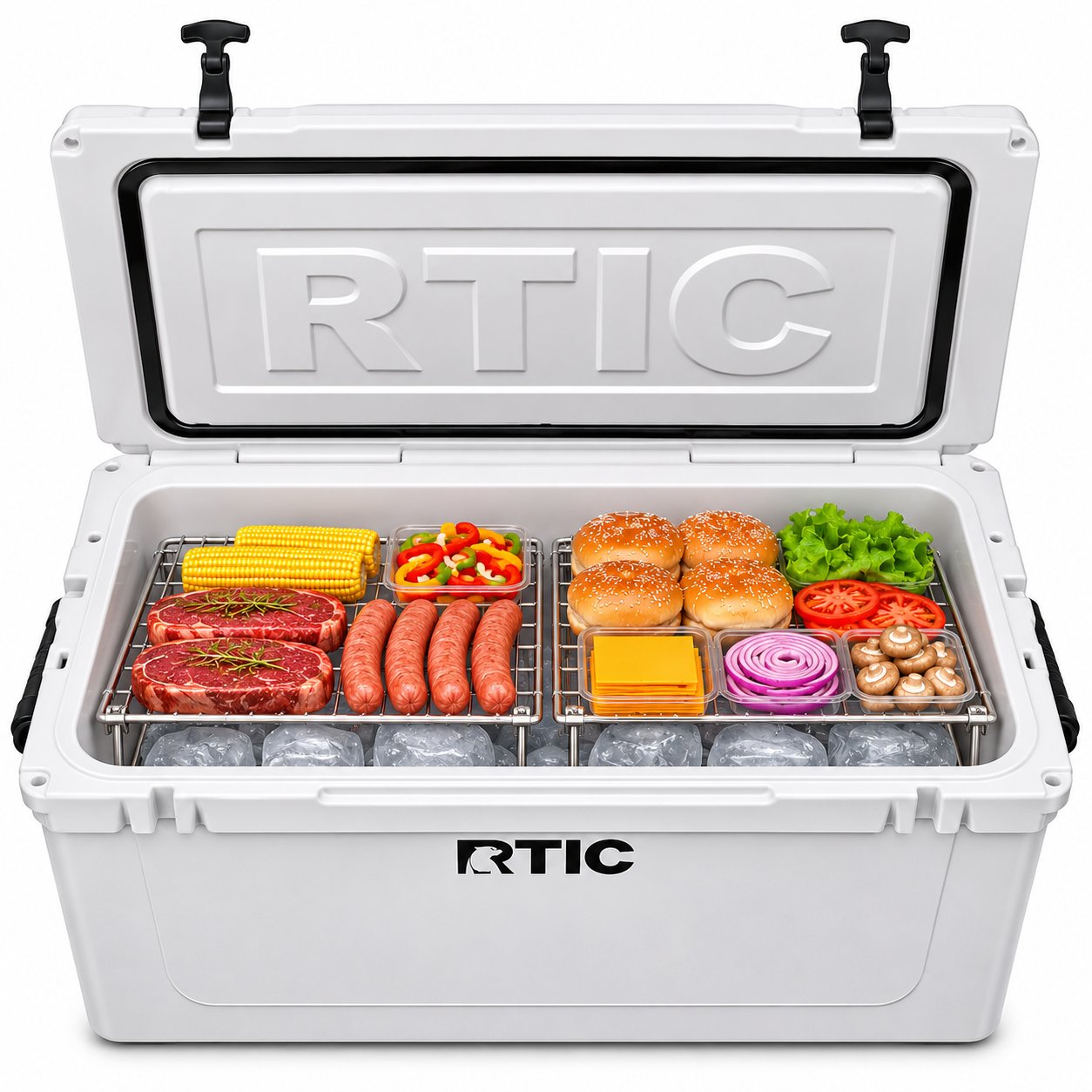
- Plan for vertical stacking. Food that sits above the ice line stays dry and stays reachable. Food that sinks into meltwater does not.
The folding stainless steel racks address this problem. If you have just realized your cooler's usable space is smaller than you thought, our guide on how to keep food dry in a cooler walks through the practical steps.
Cooler Dimensions and How to Measure Before You Buy
Measure the inside of your cooler with a tape measure, in this order: interior length at the floor, interior width at the floor, and usable interior height from floor to lid. Write the numbers down. Then measure the exterior footprint and height, because those decide whether the cooler fits your vehicle.
Measure interior dimensions at the bottom, not the top, since the floor is often the tightest point in a tapered cooler.
For rack compatibility, the CR-SS-10 needs at least 10″ of interior length, 11″ of interior width, and 7″ of usable interior height. The CR-SS-15 needs at least 15″ of interior length, 11″ of interior width, and 7″ of usable interior height. Choose by interior measurements rather than advertised capacity or brand name alone.
Matching Exterior Dimensions to Vehicle and Storage Space
Exterior size is where buyers get burned. A 90-quart cooler is a substantial object, and it will not slide under a tonneau cover or fit behind the third row of every SUV.
Check these before ordering:
- Trunk opening height, not just trunk floor space
- Truck bed length with the tailgate closed
- SUV cargo height with the second row up
- Garage or shed shelf clearance for off-season storage
A useful habit: cut a cardboard template to the cooler's exterior footprint and test it in the vehicle. It takes five minutes and prevents a return.
Cooler Size for a Family: Small, Medium, and Large Categories
Families need a cooler sized around meals, not just drinks, which usually pushes them one category up from what they would pick on instinct.
Small coolers, roughly 20-35 quarts. Best for day trips, lunch runs, and sports events. Easy to lift, easy to fit in a back seat.
CR-SS-10 Compact Cooler Rack (10″) →
Medium coolers, roughly 40-70 quarts. The family workhorse. Handles a weekend for four with food and ice, fits in most SUV cargo areas, and stays liftable when loaded.
Large coolers, 75 quarts and up. Built for multi-day camping, group trips, and base camps.
If you are packing for a big household, our packing guide for large families covers how to organize meals across that interior space. And if you are weighing a smaller soft-sided option, our roundup of camping recipes for small coolers shows what actually fits.
Cooler Size for a Road Trip: Day Trips, Camping, and Tailgating
Road trips punish the wrong cooler size more than any other use case, because you live out of the cooler for days and repack it in parking lots.
Day trips and tailgating: 30-50 quarts. Enough for drinks, sandwiches, and a side dish for a group, small enough to carry to a parking lot or beach.
Weekend camping: 50-75 quarts. Covers two to three days for a small group with block ice and a rack system.
Extended road trips: 75 quarts and up, or two coolers. Splitting into a food cooler and a drinks cooler keeps the food cooler closed, which protects ice retention. Every time the lid opens, cold air escapes.
That two-cooler strategy is the single biggest upgrade for long trips.
For a detailed breakdown by trip type, our road trip packing guide walks through it step by step.
Soft-Sided vs. Hard-Sided Cooler Sizing
Soft-sided and hard-sided coolers are sized on different logic, and the quart numbers do not translate directly.
Soft-sided coolers win on portability and under-seat fit. They compress, they carry on a shoulder, and they slide into tight vehicle storage. What they lose is ice retention and structural space.
Hard-sided coolers generally hold their shape, accept interior accessories, and can keep ice for longer periods.
The practical split: soft-sided for short trips where you carry the cooler by hand, hard-sided for anything where ice needs to last and food needs to stay organized. Cooler Racks products are designed for hard-sided coolers only.
How to Pack a Cooler So Capacity Actually Works
Packing order decides whether your cooler's capacity works for you or against you. Follow this sequence and a mid-size cooler will outperform a larger one packed badly.
- Pre-chill the cooler. Add a bag of ice, close the lid, and let it sit before loading.
- Lay block ice or a frozen jug on the floor. Block ice melts slower than cubes and forms the cold base.
- Add drinks on the bottom. Cans and bottles tolerate being wet and they chill fastest near the ice.
- Set your rack in place. Legs down, grid over the ice, 7 inches of elevation.
- Load food on top. Sandwiches, produce, and containers sit above the meltwater line, dry and reachable.
- Fill air gaps. Crumpled towels or extra ice reduce the empty space that warm air occupies.
- Keep the lid shut. Decide what you need before you open it.
Two racks can suit larger coolers. The 25″ Full Cooler System pairs a compact and a full-size rack for two elevated zones, and the 30″ Maximum Coverage system runs two full-size racks end to end. For a smaller cooler, the 20″ Double Cooler Rack Setup provides two compact platforms.
Packing food directly against loose ice is a common mistake, because meltwater can soak into bread, produce, and packaging.
If you want the full method, our guide on how to pack a cooler for camping covers it in detail.
Sizing a cooler correctly takes only a few minutes of measuring and can help prevent soggy food. Measure your interior dimensions, run the capacity formula, and build in elevation so food never sits in meltwater.
Cooler Racks™ makes folding 304 food-grade stainless steel racks that hold food above the ice, with drinks kept below. Measure your cooler's interior length, width, and height first, then shop Cooler Racks and pack for the trip you are actually taking.
Frequently Asked Questions
What size cooler do I need for a day trip?
A 20 to 30 quart cooler handles most day trips for one or two people. That range holds roughly 12 to 24 cans plus ice, or a lunch and drinks with room to spare. If you are feeding a family of four for a beach day, step up to 45 to 55 quarts so you can fit food containers, drinks, and enough ice to last eight hours. Match the quart rating to what you are actually carrying, not to the biggest number on the shelf.
How many quarts per person for a cooler should I plan for?
Split the load across two medium-sized coolers if lifting a single large cooler is a problem.
Does advertised quart capacity match what I can actually fit?
Not always. Quart ratings measure total interior volume, including the space ice and meltwater occupy. Once you add ice, usable capacity for food and drinks drops, often by a third or more. That is why a 50 quart cooler can feel cramped on day three of a trip. Measure interior dimensions and plan for ice volume separately. Elevating food on a rack such as the CR-SS-15 Full Size Cooler Rack keeps items above meltwater and frees the space below for drinks and ice.
Should I buy a hard-sided or soft-sided cooler?
Soft-sided coolers win on portability and under-seat fit, which suits short trips and small groups. Hard-sided coolers hold ice longer and hold their shape when packed tight, which matters for camping, fishing, and multi-day travel. If you want to keep food dry and organized inside a hard-sided cooler, a stainless steel rack like the CR-SS-10 Compact Cooler Rack creates a raised shelf above the ice. Note that Cooler Racks products are designed for hard-sided coolers only.
How do I know a cooler rack will fit my cooler?
Measure the inside of your cooler, not the outside. The CR-SS-10 needs at least 10 inches of interior length, 11 inches of interior width, and 7 inches of usable interior height. The CR-SS-15 needs 15 inches of interior length with the same width and height. Bundles need 20, 25, or 30 inches of interior length for end-to-end setups. Choose by usable interior measurements rather than brand or quart rating alone, and check the size guide before ordering.
How much ice should I add to a cooler for a two-day trip?
Block ice melts more slowly than cubes, so a block plus a layer of cubes can help with staying power. Pre-chilling food and drinks before packing is also helpful. Actual ice retention depends on the cooler, outside temperature, how often you open the lid, and how full the cooler is.
